
Fertility tests for men
Male fertility is just as important as female fertility, and testing can give you valuable information about your reproductive health. Whether you are trying to conceive, planning ahead, or preparing for fertility treatment, a fertility test for men can help you better understand your options.
Male factors can play a role in fertility challenges, despite the common misconception that fertility is mainly a woman’s issue. The encouraging news is that some aspects of sperm health can be supported through lifestyle, nutrition, and targeted medical guidance.
Our male fertility tests may include Semen Analysis, Sperm DNA Fragmentation testing and Blood Tests. Together, these results help our team build a clearer picture of sperm health, overall fertility potential, and which next steps may be most suitable for you.

What fertility tests are available for men?
Fertility tests for men are used to assess sperm health and other factors that may affect fertility. The first test is usually a Semen Analysis, which assesses sperm count, motility, and morphology. In simple terms, this means how many sperm are present, how they move, and what they look like.
In some cases, further testing may be recommended. A Sperm DNA Fragmentation test can look for possible damage to the DNA inside sperm cells. Blood tests may also be used to check hormones, general health markers, or other fertility-related factors.
A fertility test for men does not define your future on its own. Your results are reviewed alongside your medical history, lifestyle, fertility goals and, where relevant, your partner’s results. This allows our doctors to give you clear, balanced advice based on your individual situation.
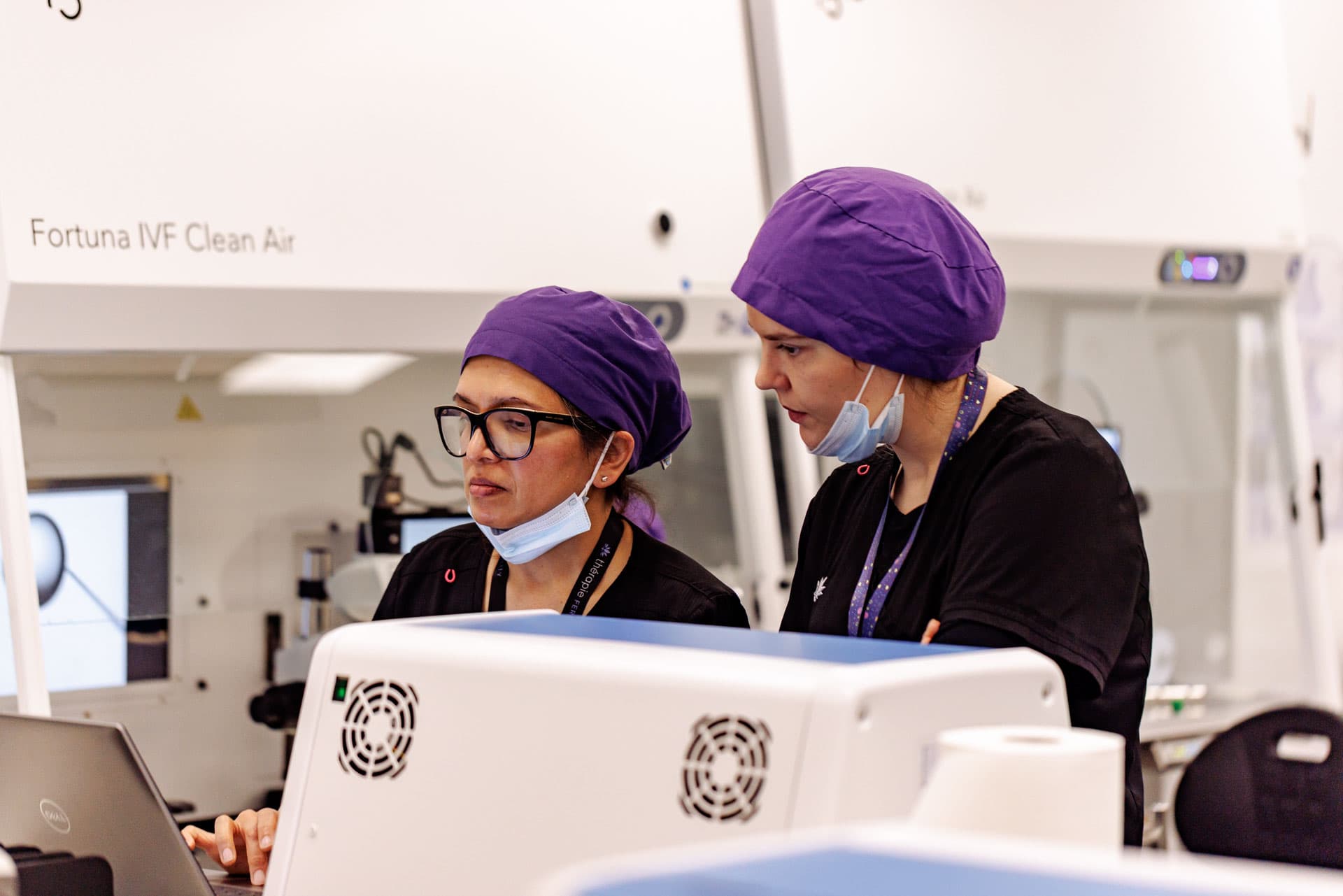
The male fertility testing process
Why get male fertility tests?
Male fertility testing helps us understand whether sperm factors may be affecting your chances of conception. It can also highlight opportunities to support sperm health before trying to conceive naturally or before starting fertility treatment.
Modern life can affect sperm quality. Heat exposure, smoking, binge drinking, steroid use, tight clothing around the testicles, diet, stress and general health may all play a role. In some cases, simple lifestyle and dietary changes can support sperm health over time.
Testing can also help guide treatment planning. One of the biggest advances in male infertility treatment has been ICSI, where a single sperm is injected directly into an egg. This can be helpful in some cases of male factor infertility, where sperm count, movement or shape may make fertilisation more difficult.
If no sperm are found in the sample, our team may recommend further investigation. Where appropriate, treatment options such as surgical sperm retrieval may be discussed.

What our patients say
Victoria Kalandadze
2 weeks agoI had the most attentive and amazing experience with Thérapie Fertility from the moment I walked in for my consultation. It was incredibly informative, and I felt genuin…
Google ReviewIgotboomed Google Account
2 weeks agoWe started our journey with Thérapie in January 2024, after so many years of struggle and being let down by the NHS. We were terrified to reach out to a private clinic, b…
Google ReviewAndy 'aree
2 weeks agoThe staff were and still are very supportive, understanding, and communicative during a difficult time.
Google ReviewLaura Kearns
2 weeks agoWe cannot recommend Thérapie Fertility enough. Our baby boy is now 6 months old through ICSI thanks to Thérapie which is something we once thought we would never have🩵 w…
Google ReviewAllie
2 weeks agoI froze embryos with Therapie Fertility earlier this year due to a complex medical history that may lead me to have difficulty conceiving in the future. Many clinics don’…
Google ReviewSerena Rush
2 weeks agoI cannot recommend Thérapie Fertility enough. I underwent treatment at Thérapie Fertility and the care that I received from all members of staff was absolutely fantastic.…
Google ReviewErin Shanks
3 weeks agoI honestly can’t thank Therapy Fertility both Dublin and the Belfast clinic enough for everything they’ve done for me and my family. From the very beginning of our journe…
Google ReviewNicole Hempenstall
3 weeks agoI could not recommend therapie fertility more I have told so many friends and family about their welcoming, kindness and relaxed environment they provide. We were so luck…
Google ReviewKatie Chadburn
3 weeks agoWow where do I even begin!? The care, empathy, skill and joy this clinic bring to their patients is really something other clinics should aspire to. We had our IVF round …
Google ReviewA C
4 weeks agoWriting this review with my 6 month old in my arms. I will forever be grateful to all the team in Thérapie ❤️ our first round of ICSI was successful and we were supported…
Google ReviewDorina Bukhtiar-solyom
a month agoWe cannot thank the team at Thérapie Fertility Carrickmines enough for the care, kindness, and support we received throughout our fertility journey. From our very first a…
Google ReviewAndrea Breen
2 months agoWe couldn’t recommend Thérapie Fertility more. Every question was answered, every worry was taken seriously, and we were supported every step of the way. You can really f…
Google Review
Ready to talk it through?Book a free consultation
- No waitlist
- Clinical experts
- Transparent pricing
Your fertility testing questions for men answered
See other FAQ topicsYes, there are usually steps to take prior to a semen analysis to help ensure that the result is accurate. These measures include regular ejaculation, followed by a period of abstinence in the days leading up to the test. Our team will explain these instructions clearly before your test.
A sperm analysis looks at the quantity and quality of a semen sample. It checks factors such as semen volume, sperm count, sperm movement and sperm shape.
Yes. You can have fertility testing without starting treatment. Many men choose testing to better understand their fertility health and future options. Your results can help you plan ahead and make informed decisions.
ICSI is a laboratory technique used during fertility treatment where a single sperm is injected directly into an egg. It can be helpful in some cases of male factor infertility, because it requires far fewer sperm than IVF.
An unexpected semen analysis result can feel worrying, but it can also provide useful direction. It helps us understand what may be affecting fertility and whether further testing, lifestyle changes, or treatment options may be helpful.
In some cases, sperm health may improve through lifestyle and dietary changes. Reducing smoking, binge drinking, steroid use and heat exposure may help support sperm quality. Your test results can help guide the most appropriate advice.
Yes. Male fertility is just as important as female fertility. Fertility challenges can involve male factors, female factors, both partners, or sometimes no clear cause. Testing both partners helps give a more complete picture.
A semen analysis provides information on sperm count, motility, and morphology. These results help us understand whether sperm factors may be affecting conception and whether further testing may be helpful.
The main fertility test for men is a semen analysis. This test checks sperm count, motility and morphology, which means how many sperm are present, how well they move, and what they look like.
The most common way to collect a sperm sample is for a person to masturbate and ejaculate into a sterile cup. The doctor provides a private room for you to do this. In some cases, a person can collect the semen sample at home. A doctor may recommend that the person ejaculates into a collection cup while at home. When collecting a sample at home, you must remember to keep it at room temperature and bring it to the clinic shortly after collection.
We have two main fertility tests for men, the standard semen analysis and the DNA Fragmentation test. In addition to this we can carry out various blood testing.