
242 Google reviews
Transvaginal Ultrasound
Fertility ultrasound
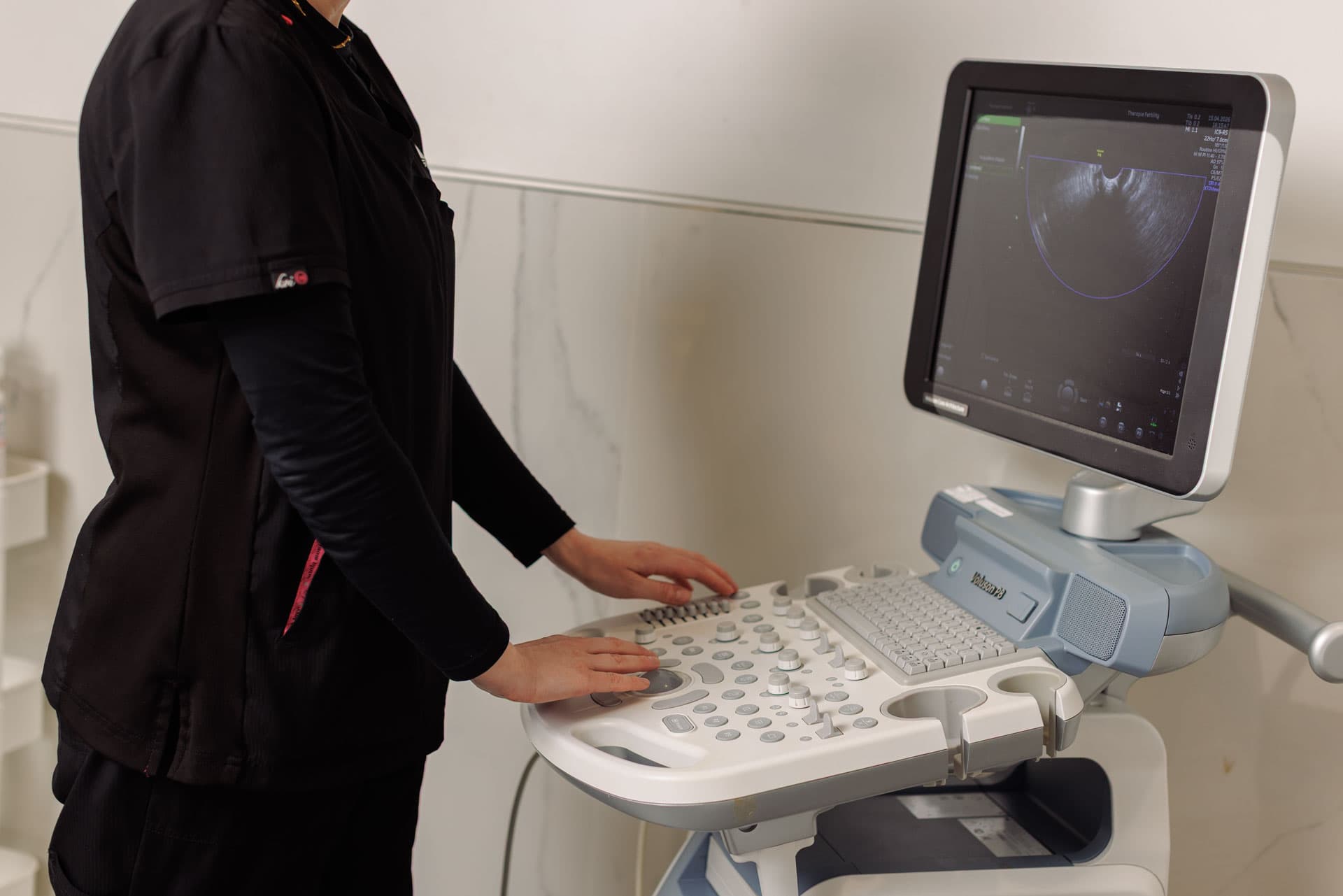
A transvaginal ultrasound is a fertility scan used to look at the uterus, ovaries and endometrial lining in more detail. It is a simple and effective way to gather important information about your reproductive health.
At our clinic, all fertility ultrasounds are carried out transvaginally. A small ultrasound probe is gently inserted into the vagina, which allows for clearer visualisation of the uterus and ovaries than an external scan. A fertility ultrasound can help our doctors understand your fertility picture, guide further testing if needed, and support treatment planning. You do not need to be ready for fertility treatment to have an ultrasound. For many people, it is simply a helpful first step in understanding their options.
Pricing
Transvaginal Ultrasounds
€130
Understanding more about transvaginal ultrasounds
with our Senior Fertility Midwife Becky
A transvaginal ultrasound is an internal ultrasound scan that uses a small probe placed into the vagina to create images of the reproductive organs. It helps our team see the uterus, ovaries and endometrial lining more clearly.
Why do we use a transvaginal ultrasound?
A fertility test for women, such as an ultrasound, may be recommended as part of wider fertility testing, alongside blood tests such as AMH. One test does not tell the full story, so your results are reviewed alongside your medical history, menstrual cycle, symptoms and fertility goals. We use transvaginal ultrasound because it gives valuable information about the uterus and ovaries. It can help us understand what may be happening in your cycle, whether further testing may be useful, and which fertility options may be most suitable for you.
A transvaginal ultrasound may provide information about the ovaries, visible follicles, uterine cavity, endometrial lining and ovarian reserve. It can also help identify findings that may need further review before treatment. In some cases, a more specialised ultrasound, such as HyCoSy, may be recommended to assess the uterine cavity and fallopian tubes in more detail.
The results of your scan are always reviewed as part of your wider fertility picture. This helps our doctors give you clear, personalised advice based on your individual circumstances, rather than on a single result.

What our patients say
Victoria Kalandadze
2 weeks agoI had the most attentive and amazing experience with Thérapie Fertility from the moment I walked in for my consultation. It was incredibly informative, and I felt genuin…
Google ReviewIgotboomed Google Account
2 weeks agoWe started our journey with Thérapie in January 2024, after so many years of struggle and being let down by the NHS. We were terrified to reach out to a private clinic, b…
Google ReviewAndy 'aree
2 weeks agoThe staff were and still are very supportive, understanding, and communicative during a difficult time.
Google ReviewLaura Kearns
2 weeks agoWe cannot recommend Thérapie Fertility enough. Our baby boy is now 6 months old through ICSI thanks to Thérapie which is something we once thought we would never have🩵 w…
Google ReviewAllie
2 weeks agoI froze embryos with Therapie Fertility earlier this year due to a complex medical history that may lead me to have difficulty conceiving in the future. Many clinics don’…
Google ReviewSerena Rush
2 weeks agoI cannot recommend Thérapie Fertility enough. I underwent treatment at Thérapie Fertility and the care that I received from all members of staff was absolutely fantastic.…
Google ReviewErin Shanks
3 weeks agoI honestly can’t thank Therapy Fertility both Dublin and the Belfast clinic enough for everything they’ve done for me and my family. From the very beginning of our journe…
Google ReviewNicole Hempenstall
3 weeks agoI could not recommend therapie fertility more I have told so many friends and family about their welcoming, kindness and relaxed environment they provide. We were so luck…
Google ReviewKatie Chadburn
3 weeks agoWow where do I even begin!? The care, empathy, skill and joy this clinic bring to their patients is really something other clinics should aspire to. We had our IVF round …
Google ReviewA C
4 weeks agoWriting this review with my 6 month old in my arms. I will forever be grateful to all the team in Thérapie ❤️ our first round of ICSI was successful and we were supported…
Google ReviewDorina Bukhtiar-solyom
a month agoWe cannot thank the team at Thérapie Fertility Carrickmines enough for the care, kindness, and support we received throughout our fertility journey. From our very first a…
Google ReviewAndrea Breen
2 months agoWe couldn’t recommend Thérapie Fertility more. Every question was answered, every worry was taken seriously, and we were supported every step of the way. You can really f…
Google Review





Your transvaginal ultrasound questions answered
Quick answers to the questions we hear most often about transvaginal ultrasound at Thérapie Fertility.
View all Transvaginal Ultrasounds questionsAn unexpected HyCoSy result can feel difficult to receive, but it can also provide valuable clarity. It may help explain why pregnancy has not happened so far, or why a particular treatment approach may be more suitable. Our doctors will talk you through your results clearly and support you in understanding the next steps.
You can have a HyCoSy appointment at Thérapie Fertility, located across Ireland. Our team will explain what the test involves, when it should be done in your cycle, and how the results may help guide your next steps in fertility.
A HyCoSy may be useful if you have suspected or diagnosed endometriosis, as it can help assess the uterus and whether the fallopian tubes appear open. However, it does not diagnose all forms of endometriosis. Your results will be reviewed alongside your symptoms, history and any other relevant tests.
Our team will advise you on sex after HyCoSy based on your individual situation and how you feel after the test. Some patients may prefer to wait until any spotting or cramping has settled. If you have been given specific aftercare guidance, follow that advice.
The difference between HSG and HyCoSy is mainly how the tubes are assessed. HSG usually uses X-ray imaging and dye, while HyCoSy uses ultrasound and contrast fluid. Our team can explain which test is most appropriate based on your circumstances.
Ready to talk it through?Book a free consultation
- No waitlist
- Clinical experts
- Transparent pricing